Tableau and dbt Labs: Strategic Partnership and Integration


Enabling teams to make trusted, data-driven decisions has become increasingly complex due to the proliferation of data, technologies, and tools. For example, through Mulesoft’s Connectivity Benchmark report we found that the average enterprise uses 991 applications. This technology sprawl often creates data silos and presents challenges to ensuring that organizations can effectively enforce data governance while still providing trusted, real-time insights to the business.
Tableau is a leader in the analytics market, known for helping organizations see and understand their data, but we recognize that gaps still exist: while many of our joint customers already benefit from dbt and trust the metrics that result from these workflows, they are often disconnected and obscured from Tableau’s analytics layer.
This can reduce trust in the data presented to decision makers, and forces analytics engineers and data stewards to replicate semantic layer definitions across their Tableau deployment. To help overcome these challenges, our community has expressed the need for an integration between Tableau and dbt to reduce friction, enforce trust in the insights, while leading to improved decision making.
At dbt Labs’ Coalesce 2024, we announced a new strategic partnership with dbt to build a seamless integration between dbt and Tableau to help our customers deliver on trusted, end-to-end analytics.
Through our new partnership with dbt, we are aiming to broaden the trust, extensibility, and value of Tableau by incorporating dbt models and metrics directly into the product. This will bring together two industry-leading solutions to accelerate time to value, foster seamless collaboration, and provide a world-class analytics experience to our customers.
Delivering on our vision together
Our vision is to bring end to end trusted data and analytics to organizations, with the data platforms of their choice.
Here are five key areas where we will deliver important features to achieve this:
- Export dbt models and metrics: Data teams can instantly create a Tableau semantic model and Tableau Pulse metric from within dbt Cloud, without the need to republish data sources into Tableau or manually set up the metric.
- Lineage and data health: We will enhance data details and data lineage in Tableau Catalog by allowing dbt to import key data health information, such as when data was last refreshed, when data quality checks passed, and more. With dbt Exposures, data teams get automatic context into how and where models are used so they can prioritize work to promote data quality and trigger related Tableau content to refresh.
- Tableau dashboards: Analysts can build visualizations based on imported dbt data models and seamlessly combine external data with metrics data for deeper analysis.
- Tableau Pulse: Tableau Pulse metrics can be directly connected to dbt models and metrics.
- Collaboration: Via Tableau apps in Slack and Teams, a user will have a search experience that bridges both platforms, allowing for the one-click creation of new Pulse metrics based off of dbt metrics, all in the flow of work.
Our partnership benefits any data-driven individual, at any level, in any organization:
- Business users can trust the insights they receive from Tableau, predicated on the dbt governance layer, increasing self-service capabilities.
- Data professionals no longer have to replicate their dbt semantic layer into Tableau’s own version of a semantic layer, and can reduce time spent servicing ad-hoc requests on data quality, freshness, access, and creating new analytics and metrics for business users and key decision makers.
- Key stakeholders will increase their overall trust in data in their organization, leading to faster and more confident decision making.
Enabling trust and governance at every step of the analytics process
When viewing Tableau content, such as dashboards, Pulse metrics, or even published data sources, we often have an incomplete view of the underlying data. We can see structured data in the context of the Tableau environment, however, any transformations that occur before the environment are not captured or displayed.
dbt Data Health Tiles, announced GA at Coalesce 2024, provide dashboard viewers an easy way to get information on data quality and freshness checks. From Data Health Tiles embedded in Tableau dashboards, users can navigate to dbt to see the full Exposure, providing even more context about the underlying tables that make up a published data source connection in Tableau.
(Available for Tableau dashboards today.)
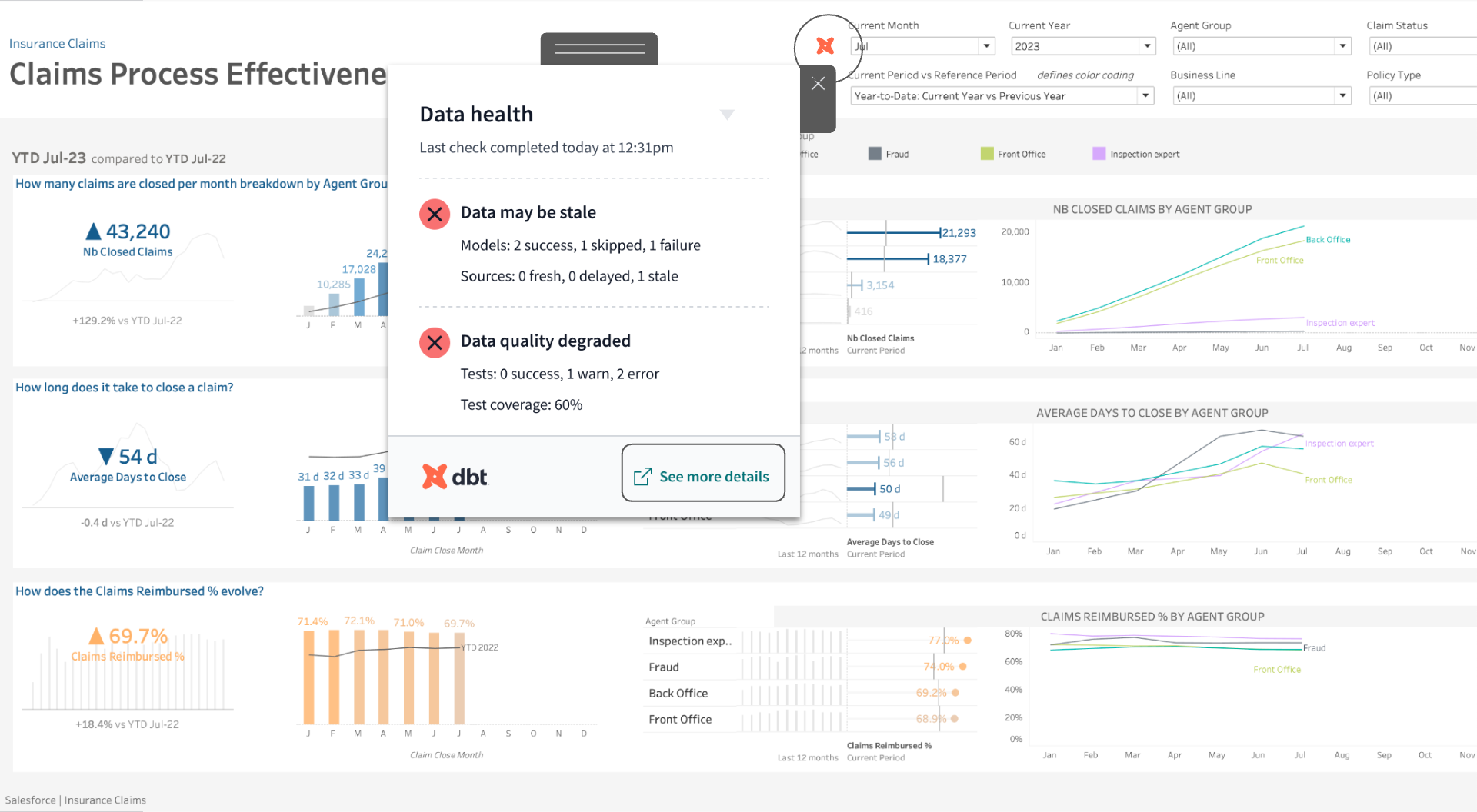
In the future, a dbt-to-Tableau Catalog integration will provide richer descriptions, and surface dbt metadata on quality checks and freshness. Within the UI of a Pulse metric, it will be easy to find added dbt metadata for more information about the Pulse metric lineage.
Bringing the dbt Metric Layer to Tableau Pulse and back
Through our one-click Publish-to-Pulse integration, users in dbt can instantly create a trusted Pulse Metric that is always up to date, and always connected to the dbt Metrics Layer. In an Exposure in dbt, it will be easy for an analytics engineer to explore the model by using “Explore in Tableau” functionality in an ephemeral Tableau interface before publishing and certifying content in dbt, all without having to leave their flow of work.
(Coming soon!)
dbt Cloud Semantic Layer Connector to Tableau Cloud
The dbt Semantic Layer connector is available to Tableau Server customers in the Tableau Exchange today. As the modern data landscape continues to evolve, organizations are managing increasingly complex data ecosystems. We’ve heard from Tableau and dbt customers on how analytics teams struggle to maintain consistency between their dbt-defined metrics and their Tableau Cloud visualizations. This disconnect has forced data teams to rebuild semantic definitions across multiple platforms, creating friction for analytics engineers, analysts and business users.
The dbt Semantic Layer connector is now available in Tableau Cloud as part of Tableau 2025.2. For organizations leveraging both the dbt platform and Tableau Cloud, this integration eliminates a critical gap in the modern data stack. Data teams can now seamlessly connect their dbt semantic layer directly to Tableau Cloud, ensuring trusted analytics built on trusted and centrally defined metrics.
Empowering Every Analytics Role
- Business Users gain access to trusted, self-service analytics capabilities in the cloud, with the confidence that their numbers are based on centralized business logic.
- Data Analysts can focus on generating insights rather than reconciling or duplicating metric definitions in Tableau and the dbt platform. They can create and share analytics insights, knowing that metrics are standardized across multiple platforms and departments.
- Analytics Engineers no longer need to maintain separate semantic layers for cloud and on-premises deployments. They can define metrics once in dbt and trust that those definitions are properly and consistently delegated to Tableau.
Enabling Trusted Self-Service Analytics in the Cloud
Tableau Cloud support for the connector will enable:
- Enhanced Data source and Dashboard Authoring: Published data sources and dashboards can be authored in Desktop or natively in web authoring
- Delegated aggregation: Published data sources in Tableau Cloud can be connected live to the entire semantic layer model or saved queries, delegating metric definition and aggregation to the dbt platform
- Tableau Pulse Integration (coming soon): Pulse metrics will soon be able to directly connect to dbt models and metrics
Technical Implementation and Getting Started
The dbt Semantic Layer connector and driver are available for all Tableau Cloud customers.
To get started with the connector in Tableau Cloud, you will need:
- A dbt Cloud Team or Enterprise account with dbt version 1.6 or higher
- The dbt Semantic Layer configured in dbt
- PAT, hostname, environment ID from dbt
- Driver and taco file installed on personal machines for Tableau Desktop
Collaborate in the flow of work
Making dbt metrics and Tableau Pulse Metrics available in the flow of your work should be easy and trusted. A Slack or Teams user will be able to use the Tableau app to surface Pulse Metrics, search for unpublished dbt metrics, and interact with the app to one-click publish dbt metrics to Pulse.
(Coming soon!)
Looking Ahead: The Future of dbt and Tableau
Enabling the dbt Semantic Layer in Tableau Cloud is the first step to standardizing external metrics in Tableau. We are excited to bring deeper integrations, such as an improved UI for dashboard authoring when using delegated metrics, ability to combine external metrics with Tableau defined metrics, or even other relational data sources.
The dbt Labs and Tableau partnership is focused on enabling trusted data and analytics, with any data platform of choice. As we continue to partner with dbt Labs, we're excited to see how our community will leverage both platforms to accelerate their analytics initiatives and drive more confident decision-making across their business.
How do I get started?
To get started, enable the dbt Cloud connector on your Tableau Server today, and set up Data Health Tiles as web page elements in your dashboards.
We’re excited to add more functionality to our integration—stay tuned for future product announcements!
Zugehörige Storys

VizQL Data Service: Extend Your Data Beyond Visualizations
 19 März, 2025

How to Use VizQL Data Service in Your Tableau Cloud Site
16 Oktober, 2024
VizQL Data Service from Tableau: Use Your Data, Your Way
 8 August, 2024