
Transforming Data into Action for Marketing, Customer Success, and Sales: How Tableau Next Fuels Faster, Smarter Insights at Salesforce
Tableau Next is redefining business intelligence with agentic analytics, transforming how businesses turn data into action–and that includes our own business. At Salesforce, we pride ourselves on being the first users, or “Customer Zero,” of our products. This approach aligns with our company values of building trust and helping customers succeed, as we ensure that our innovations are secure, stable, and cutting edge for the greatest impact.
Marketing, Customer Success, and Sales didn’t just experiment with Tableau Next: They built real agentic solutions that put AI to work, delivering tailored, contextual insights to reps, surfacing customer health signals before they escalate, and guiding leaders with data-driven actions.
The result? Faster, smarter decisions at every level. And these solutions are more than internal wins—they’re living blueprints for how agentic analytics can augment every interaction and transform decision making across Salesforce for every employee and for every customer.
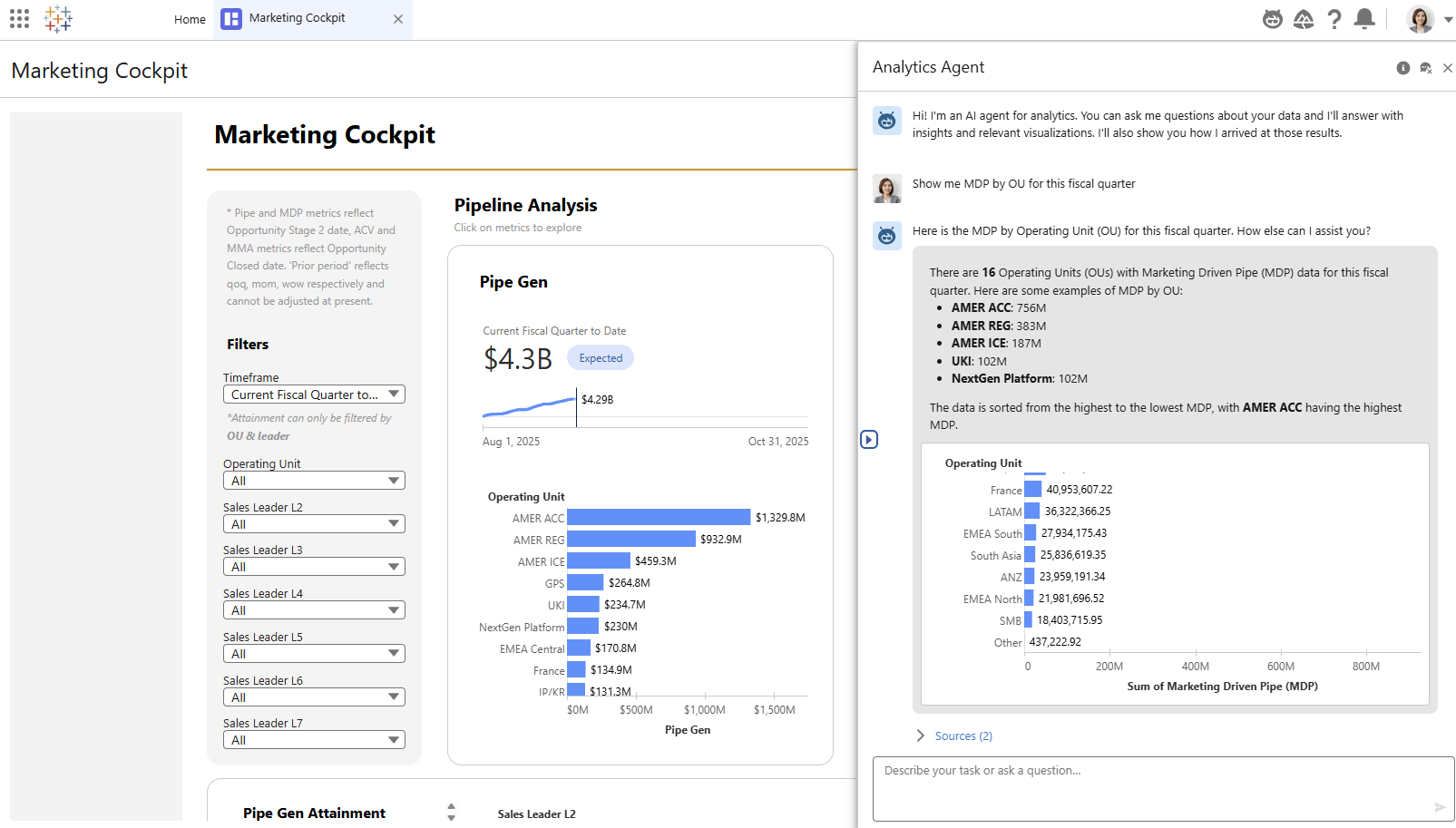
- The Marketing Analytics team built a Marketing Cockpit, a centralized dashboard with an AI agent that instantly generates insights and recommends next steps. Instead of waiting on a data expert, marketers can ask questions about campaign performance or pipeline impact and get customized, contextual answers in seconds.
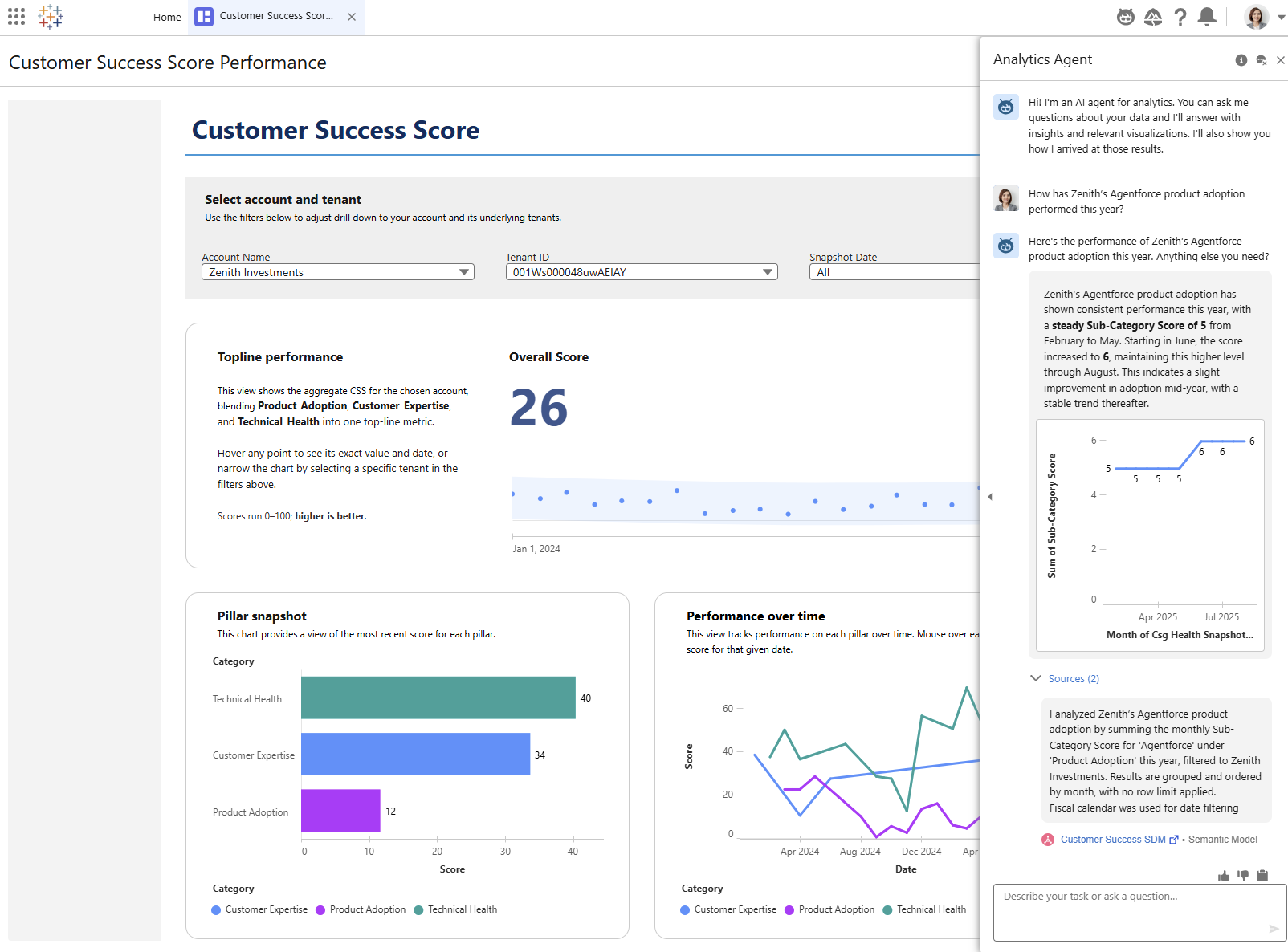
- The Success Management team transformed how customer success managers (CSMs) engage with customer success score (CSS) data by embedding agentic features in Tableau Next. Now, instead of static reports, CSMs receive proactive insights that surface risks, spotlight opportunities, and guide them toward actions that improve customer outcomes.
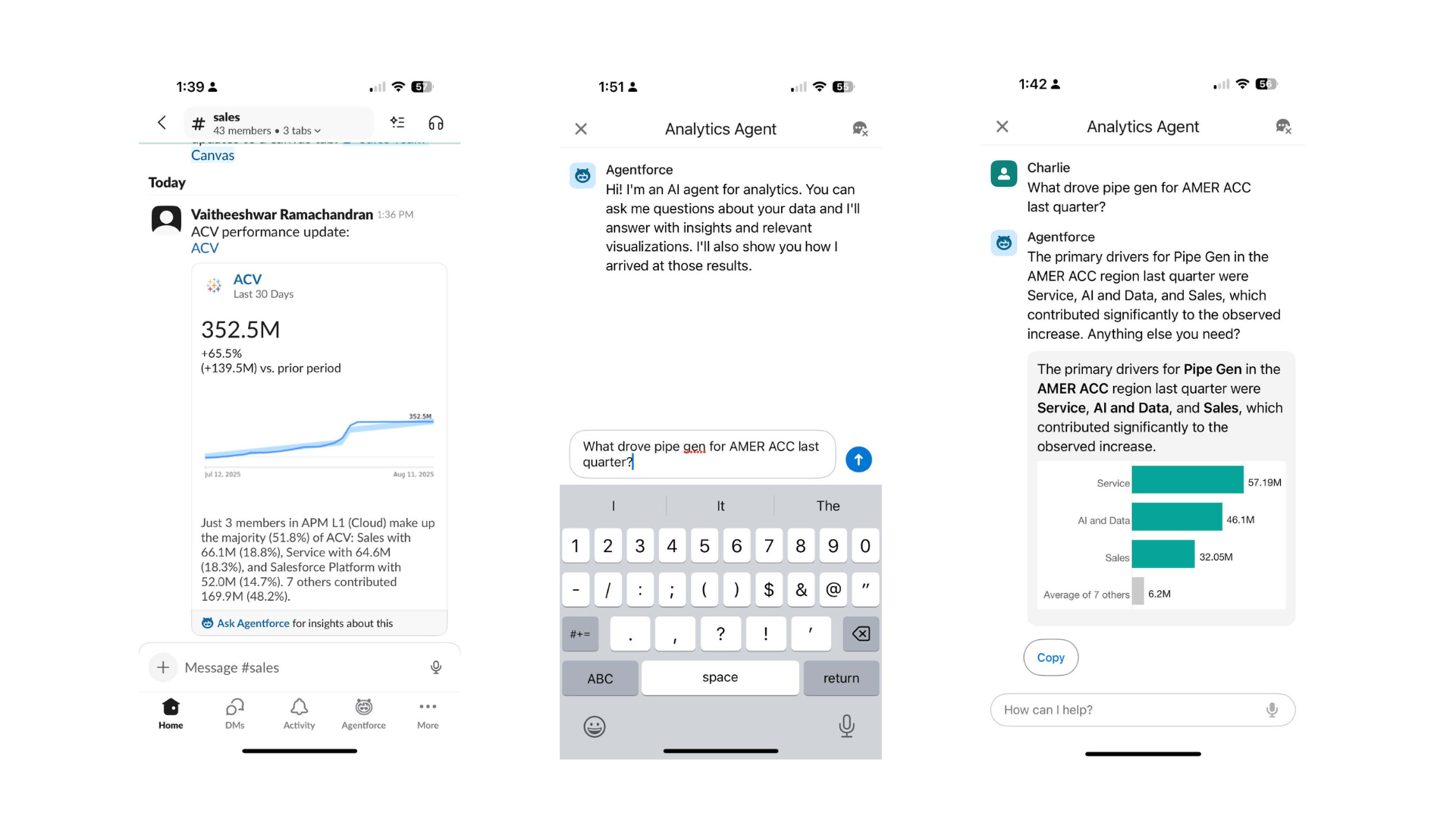
- The Sales Analytics team brought data into the flow of work with a tracker powered by Agentforce in Slack and the Salesforce Mobile app. Sales managers can track metrics like annual contract value (ACV), pipeline generation (Pipe Gen), and account executive (AE) participation wherever they are and act immediately—from planning next quarter’s pipeline to coaching reps—all from their phones.
Together, these innovations show how Tableau Next powers the agentic enterprise—turning disconnected insights into personalized, actionable intelligence that drives smarter decisions, faster and easier results, across every function.
From data to campaign optimization: how agentic analytics powers smarter marketing decisions
The Challenge
Understanding marketing’s true contribution to sales attainment has always been complex. Attribution requires stitching together data from multiple sources, applying nuanced definitions like marketing-driven pipeline (MDP), and then translating it all into insights that business users can act on. Traditionally, this work demanded significant time and the expertise of dedicated analysts.
The Marketing Analytics team set out to change that by using Tableau Next. Built on Salesforce, integrated with Agentforce, and with a unified data layer and trusted semantics, Tableau Next delivers personalized, contextual, and actionable insights to every user in every industry, right in the flow of work–making it the perfect solution for this complex problem.
Because most marketers aren’t data analysts, we wanted to explore what it would be like to ask questions to an AI agent and get insights that way, rather than having our users go to a dashboard and manually filter down to get the data they need.
How Tableau Next Helps Marketing
How Tableau Next Helps Marketing
See and act on insights in the flow of work
Tableau Next is a reimagined analytics experience that brings agentic AI into every aspect of analytics. Here is how the Marketing Analytics team built the Marketing Cockpit:
- Data foundation - The team took Sales and Marketing data from Salesforce into Tableau where it was ingested, cleaned, and connected into Data Cloud. Here is where it synthesized all of the data under the hood in its data layer and made it usable and meaningful for analysis and reporting.
- Dashboard and conversational analytics - The data was visualized in Tableau Next in the Marketing Cockpit dashboard and connected with Agentforce to enable conversational queries.
- Semantic modeling - The Engineering team built a semantic data model using Tableau Semantics to standardize key concepts and metrics like MDP by unifying data and metadata, to enrich AI with context. Now, every query pulls from a trusted, single source of truth, so marketers get accurate, context-rich answers relative to their business.
With that foundation in place, the team tested Concierge across a range of questions ranging from broad (“Show me MDP by operating unit or ‘OU’ this quarter”) to specific (“Which product is driving commercial MDP for AMER accounts this quarter?”).
Building the semantic layer for this use case is much more than just a data lineage or cataloging exercise. The more we invest in defining the data upfront and giving it the right business context, the better we can train the agent—and the easier it gets for everyone else to access trusted insights.
The Impact
By leveraging Tableau Next, marketers no longer need to wait on analysts for answers. Instead, they get instant, conversational insights grounded in a semantic model they can trust.
The best part? Marketers save hours previously spent navigating dashboards or pulling reports. And now analysts are freed from answering ad-hoc questions, giving them time to focus on deeper, more complex analysis that scales their impact.
Leaders gain clarity on attribution and MDP faster than ever—empowering smarter, data-driven decisions at scale. This Marketing Cockpit use case is a blueprint for how agentic analytics transforms marketing performance—making insights accessible, actionable, and trusted across the business.
From data to better customer success scores: how agentic analytics improves account health
The Challenge
A customer’s Customer Success Score (CSS) gives customer success managers (CSMs) a quick snapshot into the health of their account. Like any good diagnosis, CSS measures and scores across different components like product adoption, technical health, and customer expertise. At Salesforce, our scores draw on nearly 200 signals that track everything from licenses used to attendance at Salesforce events.
Historically, the challenge has been the manual work involved in finding the right customer data quickly, without applying many filters or digging into traditional dashboards, searching specific slides, and so on.
The Salesforce Success Management team wanted to simplify the experience and transform how CSMs engage with their data day to day by building a solution with Tableau Next and Agentforce, unlocking personalized, contextual, and intelligent insights for customer success managers.
How Tableau Next Helps Customer Success
Transforming customer success: real-time conversations about account health
Now, thanks to Agentforce in Tableau Next, the Success Management team has developed a use case that augments CSMs to engage with customer data in new ways for faster, smarter decisions to improve account health. Here is how the team built the overall account health use case:
- Data foundation - The team brought customer account data from Salesforce into Tableau, connected it to Data Cloud, and created a single source of governed, trusted insights—giving every CSM consistent visibility and access, no matter where they work.
- Dashboard and conversational analytics - In Tableau Next, the team built an Overall Account Health dashboard that brings customer health and score data to life. With pre-built Agentforce analytics skills in Tableau, CSMs can go beyond the dashboard—asking questions in natural language, getting contextual insights, seeing tailored visualizations, and receiving proactive alerts that reveal how scores are trending and why. These answers are surfaced as contextual insights, custom visualizations, and proactive alerts about different facets of the customer’s score and how they are trending historically.
- Semantic modeling - At the heart of this solution is Tableau Semantics, the AI-powered semantic layer that bridges raw data and the AI agent. By embedding rich business context, Tableau Semantics ensures responses are accurate, governed, and meaningful—delivering insights CSMs can trust and act on with confidence.
The CSM solution enhances and builds upon the valuable information available in existing internal Tableau dashboards, but takes a significant step further by delivering actionable insights directly where work happens. This streamlined approach breaks new ground by accelerating time to insight and fostering a deeper understanding of customer data by bringing personalized, actionable information directly into the user's workflow.

A big achievement of the team with Tableau Next’s deep integration with Agentforce is that CSMs can talk in business language and get the answers they need quickly. And I’m happy to say that the success of this initiative was built on an extremely close and collaborative partnership with the Tableau product team.
The Impact
With Tableau Next powered by Agentforce, CSMs–regardless of their analytics skill level–can get actionable insights into CSS and account health using business language. No matter who is asking the question, they’ll get the same governed and trusted insight experience across all analytics needs.
And an added bonus: Success managers can share answers across Slack and in dynamic dashboards for immediate feedback and commentary from peers. They’re saving hours of work they would’ve spent generating reports and spreadsheets.
Organizations can quickly understand customer success scores, how their customers realize value from Salesforce solutions, and make smarter decisions about improving account health at scale.
From data to action from anywhere: how agentic analytics powers sales insights into strategy
The Challenge
Your sales reps and leaders need answers—like yesterday. Data buried in charts, spreadsheets, or across applications can take time and expertise to interpret and get insights from fast. At Salesforce, our Sales team is no different. Tracking metrics like annual contract value, pipeline generation, and account executive participation and performance and knowing which proactive steps to take can be tricky—especially while on the go.
That’s why the Sales Analytics team built a use case highlighting Tableau Next and Agentforce, with pre-built analytics skills like Concierge, to bring impactful, game-changing agentic analytics to the sales organization.
How Tableau Next Helps Sales
Empower your sales team to act on insights from anywhere, instantly
Tableau Next brings agentic analytics to sales organizations to make it easy for reps and leaders alike to ask questions of the data and receive trusted answers with their personalized business context. The data-driven insights are helping our Sales organization achieve goals with customized dashboards enhanced with Agentforce that make it easy to prioritize top opportunities, identify account whitespace, and quickly answer critical questions like:
- How many opportunities exist
- What the total open pipeline value is
- What the weighted pipeline looks like when adjusted for likelihood to close
- Which stages open opportunities are in
- How the pipeline looks across different industries
Here is how the Sales Analytics team built the tracker in the Salesforce Mobile app and Slack:
- Data foundation - With Tableau Next, the Sales Analytics team transformed raw Salesforce data into actionable insights—seamlessly connected to Data Cloud. Critical KPIs like ACV, pipeline generation, and AE participation aren’t just tracked—they’re made meaningful, enabling smarter, faster decisions across the business.
- Dashboard and conversational analytics - The Tableau insights were surfaced in the natural flow of work—in this case in the Salesforce Mobile app—enabling conversational queries powered by Agentforce about sales KPIs, ACV trends and outliers, and more. The agentic analytics experience made it easy for leaders to identify successes wherever they are and act immediately—from planning next quarter’s pipeline to coaching reps—all from their phones.
- Semantic modeling - A critical component of this component came from the semantic data model built by the Engineering team in Tableau Semantics to standardize metrics like AE participation, PG, and more, so that each query uses a trusted data source. Tableau Semantics infused the sales data with business knowledge to drive more accurate responses and relevant insights across the organization. Now, sales reps and leaders can use the same definitions and get answers with customized business context unique to their accounts, regions, industries, and more.
The Impact
Tableau Next’s native Slack integration lets sales leaders share live metrics and dashboards directly in channels, DMs, and canvases—driving collaboration and making it easy to replicate successes. And because it’s built on the deeply unified Salesforce platform, they can do it anytime, anywhere from their mobile device.
These example use cases for the Salesforce Sales team are some of the impactful ways customers can empower their own sales reps with personalized, accurate insights to make smarter decisions and hit or surpass targets.
The Tableau Difference
These Customer Zero examples show how Tableau Next unleashes AI-powered business intelligence, setting the standard for agentic analytics. At Salesforce—and for our customers—it turns data into action, transforming the way business gets done.
With Tableau Next, getting the most from dashboards no longer requires analytics expertise—just the ability to ask natural language questions. Powered by Agentforce and a trusted semantic layer in Tableau Semantics, everyone across organizations can get personalized, context-rich, intelligent insights, across every workflow. Now, customers can unlock the full potential of AI agents with trusted and governed business knowledge and empower the entire workforce with agentic analytics.
From Marketing to Customer Success to Sales, these innovations demonstrate how Tableau Next drives the agentic enterprise—providing actionable intelligence that accelerates smarter decisions, amplifies human-driven analytics, and makes data-driven work more scalable and valuable.