Your Semantic Data Model is the Secret to Trusted Agentic Analytics



In the era of agentic AI, the center of gravity for data and analytics is undergoing a seismic shift. For decades, the analytics community has prioritized visual outputs—charts, graphs, and dashboards—as the final destination for insights to inform action. But with the rise of intelligent agents that can analyze and act autonomously, our focus must realign towards something deeper: the semantic data model. After all, this is the foundational source code of business understanding for your data.
Why? Because trusted, effective agentic AI depends fundamentally on data with a robust and richly defined semantic model, not on handcrafted reports and dashboards.
An AI agent can instantly generate a sophisticated visualization, surface a critical insight, or even recommend the next best action—but only if it's powered by clear, comprehensive semantic definitions. A semantic model is what enriches raw data with vital business knowledge, allowing humans and agents to speak the language of the business and ensuring agents provide accurate, relevant, and actionable insights.
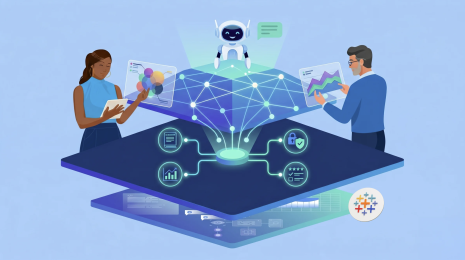
Picture the semantic data model as the gravitational core, a source of truth pulling all business insights inward. Dashboards and reports, once the star attractions, now become outputs that orbit this central, governed model. Without this solid core to ground analysis and action in truth and context, agents risk outputs becoming superficial, misleading, or outright wrong. It is the single most critical factor for ensuring agentic AI operates on a trusted, governed data foundation.
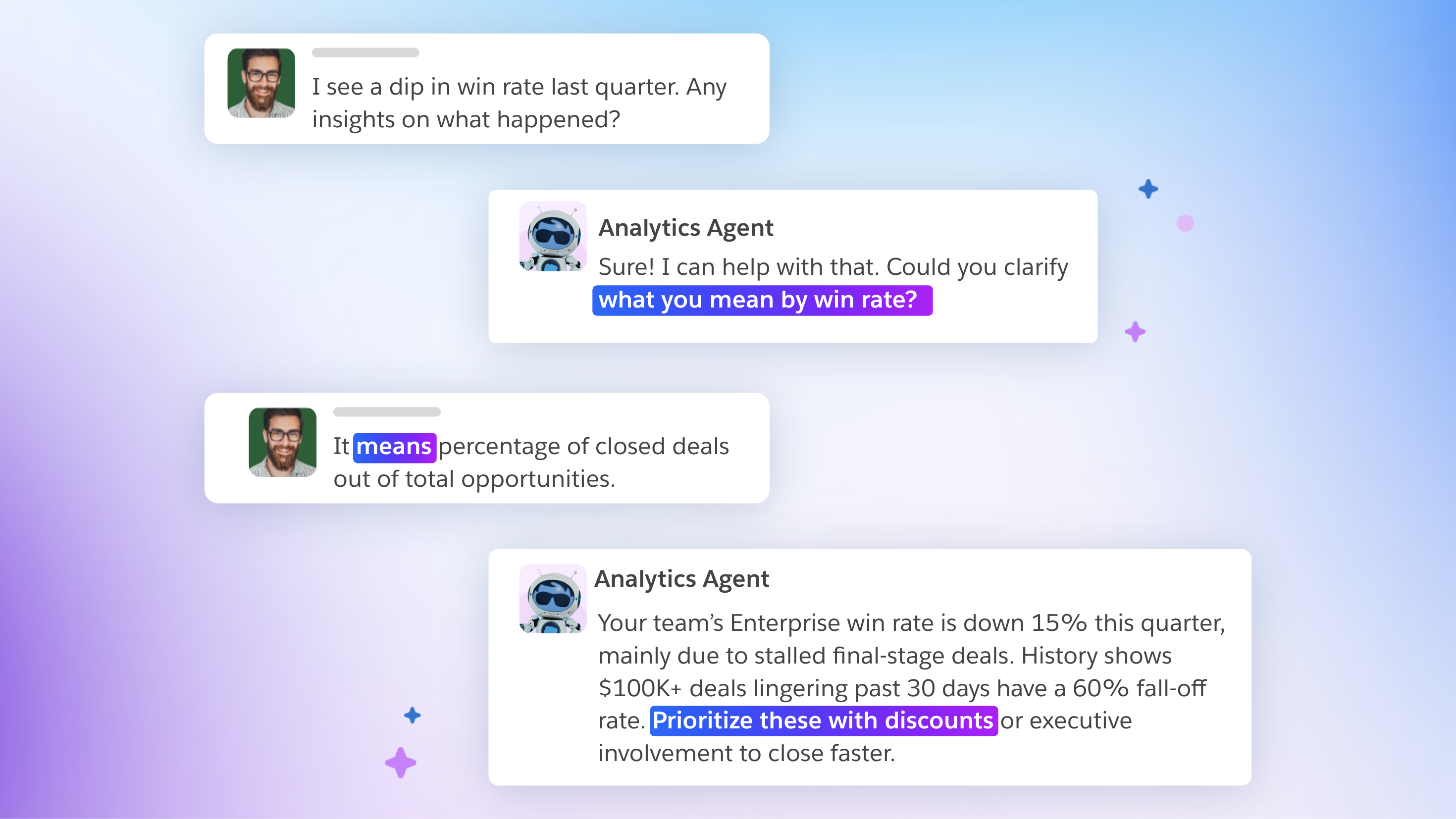
AI agents continuously learn the terms and preferences unique to your organization in order to maintain accurate and contextually relevant responses.
The evolution of the modern semantic layer to support agentic AI
This shift represents a significant evolution of the semantic model. Historically, semantic layers could be brittle, struggling to balance governance with the demands of self-service. The modern semantic layer addresses these challenges head-on, integrating classic data modeling—like joins and relationships—with a new suite of AI capabilities designed to empower analysts. Instead of a rigid structure, it's dynamic and intelligent.
This evolution transforms the analyst's role from a model builder into an AI coach. Through new AI-powered tooling, analysts can now directly embed the organization's unique intelligence into the model. This includes verifying analytical pathways for the agent, defining crucial business preferences (e.g., how Finance defines “margin”), and clarifying unique terminology. These inputs act as essential guardrails, guiding the agent’s reasoning to ensure its performance is not just fast, but also accurate and aligned with the specific business logic of your data foundation.
This new reality also changes how the semantic model grows, enabling continuous learning within a governed framework. Adopting a strategy of “paving the cowpath,” semantic enrichment happens organically.
Analysts no longer need to predict every possible business question or ambiguity. Instead, when an agent encounters an unfamiliar term or concept, it intelligently queries the user for clarification. Crucially, these answers are captured and funneled back to the analyst for review and approval. Once verified, the new context is permanently embedded in the semantic model.
This creates a virtuous cycle where real-world user interactions constantly enrich the semantic data model, making the agent progressively smarter and more trustworthy over time.
From creation to curation: The human in the loop
Stewarding business truth in the age of AI
The human role in this new world becomes more strategic, not less essential. Analysts are the stewards of business truth, guiding intelligent agents and ensuring the AI's understanding aligns perfectly with the organization's reality. And the implications are profound.
Analysts become accountable to the business for maintaining the accuracy, richness, and relevance of the semantic models that power agentic systems. This includes crucial governance responsibilities—defining permissions, embedding business rules, and ensuring the AI operates within safe, predefined boundaries. The human remains firmly in control, guiding agents to amplify analytical capabilities, not replace human judgment.
Aided by AI-powered capabilities that lower the barrier to data modeling—including intuitive interfaces, natural language capabilities, and composable, reusable assets—analysts no longer need to painstakingly assemble every element from scratch. Instead, working from a trusted data foundation, they mark AI’s corrections and approvals with a metaphorical red pen. Their role is transformed from a dashboard factory to a semantic architect; evolved from a paradigm of creation to one of curation.
The analyst’s toolbelt for teaching and testing agents
This shift from creator to curator—or from builder to AI coach—is enabled by a new class of tooling designed to enrich the semantic model and ensure agentic systems perform accurately and reliably. Rather than simply defining data relationships, the analyst’s role is now to actively test, refine, and deepen the agent's understanding of the business. This helps ensure agent responses are relevant, accurate, and trustworthy. Several key capabilities make this possible, including:
- Semantic learning and business preferences: An agent may understand your data's structure, but it doesn’t inherently know your business's unique logic or terminology. Through semantic learning, analysts can "coach" the agent by embedding specific business rules and preferences into the model. This is how an agent learns your company’s unique terminology, acronyms, and preferences—like which metrics are important to Finance or to Sales, even if they’re derived from the same base calculation. This enriches the agent's responses with critical business context, making them more accurate and relevant.
- Agent testing capabilities: Trust is paramount, and it's earned through verified performance. A testing center allows analysts to act as true AI coaches by validating agent responses against their organization's specific data, terminology, and semantic models. By testing and calibrating the agent's answers, analysts can fine-tune its performance, ensuring the insights it delivers are accurate and aligned with business needs.
- Semantic model AI readiness and optimization: To guide agents effectively, analysts need visibility into the health of the underlying semantic model. New tools leverage AI to provide insight into a model’s completeness and will identify areas for curation, such as adding descriptions or relationships between data objects. This helps analysts optimize the semantic data model, which in turn boosts the performance and reliability of the agentic systems that depend on it.
Putting it into practice: Power true conversational analytics with semantics
The agentic age is here, redefining what’s possible with data. By investing in semantic data model readiness today, businesses aren't just adapting to a new trend; they are laying the essential, trustworthy foundation needed to thrive in a future of intelligent, governed, and truly conversational AI.
However, building the robust foundation required for trusted, effective agentic analytics can seem like a monumental task for any organization. Fortunately, being part of the Salesforce family enables us to accelerate the agentic journey so our customers can succeed with practical applications of agentic AI faster.
The world’s first agentic analytics platform, Tableau Next, is designed to provide this foundation out of the box with Tableau Semantics. The unified, trusted, and AI-powered semantic layer lowers barriers to semantic modeling, enables agility with data integrity, and continuously improves agent performance:
- Through Semantic Learning, AI will constantly refine its knowledge of your unique business logic, terminology, and preferences, ensuring its responses are always accurate and contextually relevant.
- A dedicated Concierge Testing Center helps validate the agent’s answers against your specific data and rules, so you can fine-tune its performance and trust the insights.
- Semantic Data Model AI Optimization gives you clear visibility into your semantic model's health and AI-readiness, with automated recommendations to improve it for maximum agent performance and reliability.
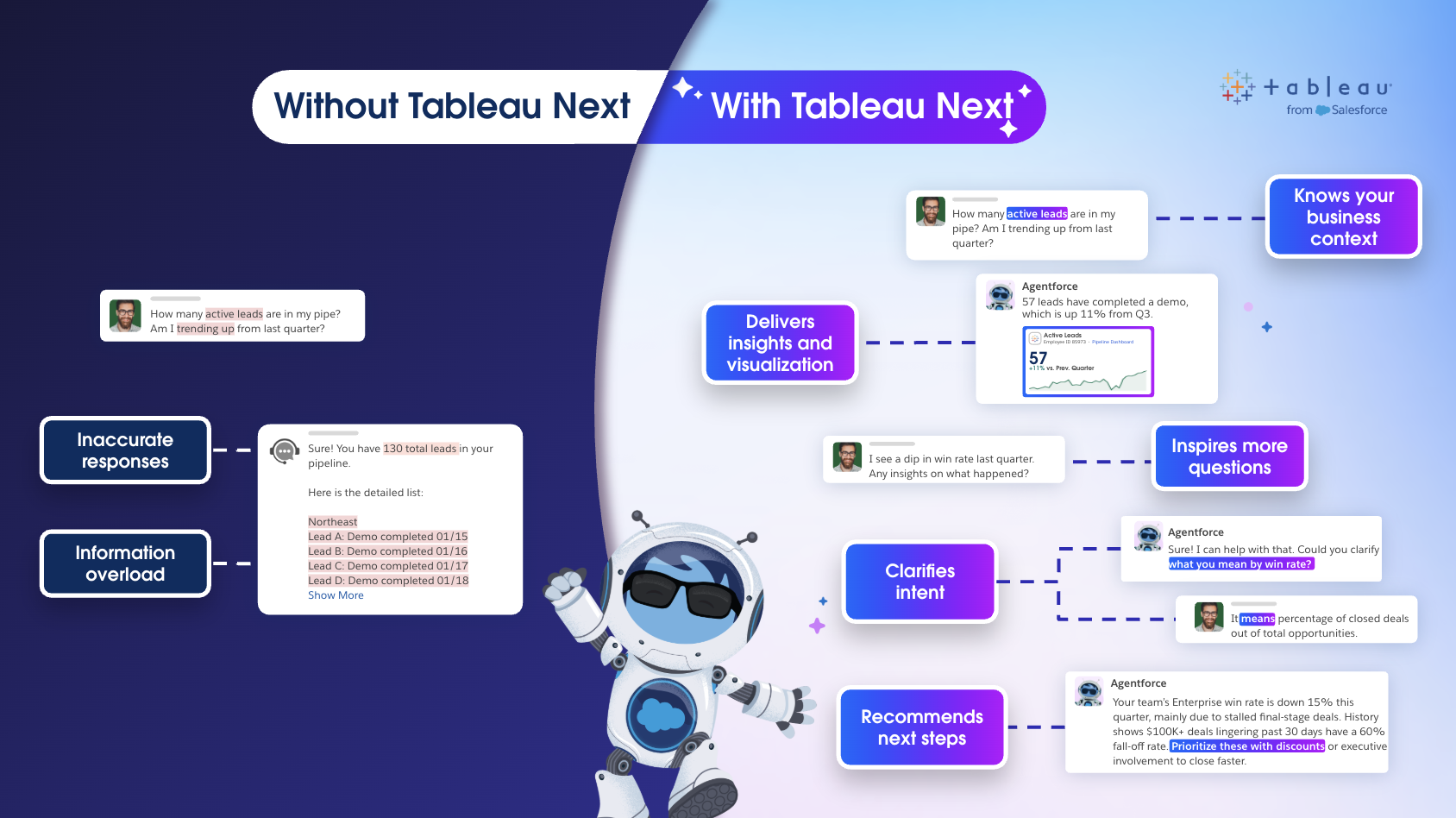
With Tableau Semantics, your agent knows how your organization defines terms like "active lead," "trending up," and the exact date range for "last quarter."
Tableau Next also enriches Agentforce with pre-built analytics skills, so agents across your organization provide more than just a text response. They can generate relevant data visualizations, recommend a next step, or even take an action—turning a simple question into a strategic, data-driven decision.
Want to learn more?
- Watch my discussion on LinkedIn on the importance of the semantic data model for enabling true conversational analytics. You’ll learn how natural language query is just the tip of the iceberg, and about the risks of a piecemeal, DIY approach.
- Read about how Salesforce is co-leading the Open Semantic Interchange, a first-of-its-kind alliance of industry leaders to build towards an open, interoperable future.
Histórias relacionadas
How Tableau Built Agentic Analytics at Salesforce: A Four-Part Framework
 12 Outubro, 2026
What is Tableau Knowledge?
 30 Setembro, 2026
The Knowledge Engine: How We Built Trustworthy Agentic Analytics
 30 Setembro, 2026