
Engine Turns Data Insights into Better Customer Experiences with Tableau Next
Realized $2 million in cost savings
Boosted customer satisfaction by 20%
Reduced average customer handle time by 15%
Engine uses Tableau Next, Agentforce, Data 360, and Slack to revolutionize how it interacts with business travelers and internal employees. By leveraging Agentforce to create powerful AI agents and Tableau Next to build dashboards that monitor these agents’ daily performance, Engine has made continuous improvements and optimizations that have boosted customer satisfaction by 20%, generated $2 million in savings, and reduced customer handling time by 15%.
About the Company
Founded to modernize a historically complex industry, Engine has quickly become a leader in travel technology, recently reaching a $2.1 billion valuation. The platform powers mobile-first booking, automated approvals, and fraud detection, providing a faster, smarter way to manage business travel at scale. The result: smoother trips for travelers and fewer headaches for companies.
Tableau Next has simplified tracking our key metrics, customer satisfaction and how effectively our internal teams are servicing customers. Having a unified view of all our agents is wildly impactful. Another beautiful thing about Tableau Next is the ability to build semantic models using natural language. That’s where we’re going to see the next big unlock.
The Challenge
Rigid, Custom-Built Analytics
Engine, a Denver-based travel technology company with a private hotel booking platform, had a goal to harness the power of AI to augment its existing team of 350 client service staff and improve its customer support experience. However, it was struggling with a custom-built analytics system that was difficult to maintain. Although the company was using AI agents to communicate with customers, it lacked crucial insights into customer intent, utterances, and the performance and satisfaction its agents were generating.
“Beyond a CSAT score, we didn’t know how happy or satisfied our customers were with the answers that they were getting from AI,” said Joshua Stern, Director of GTM Systems at Engine.
Agentic AI Meets World-Class Visualization
Engine already was a Salesforce CRM and Agentforce customer, but decided to take its service operations to the next level by adding Data 360 and Tableau Next. A few key questions they needed to answer:
- Do we have the right level of visibility to understand what our agents are saying?
- How are our agents in Slack and CRM interacting with internal customers and customer-facing staff?
- How effectively are our AI agents interacting with external customers and making their travel experience better?
Thanks to the Agentforce’s agentic capabilities, Engine created several all-new agents that serve internal users and external customers. They include:
Eva: Engine Virtual Agent goes far beyond a simple Q&A bot and can process a customer’s cancellation request versus just capturing intent and sending it along to a human service rep.
Cloe: Client Operations Expert strengthens client-facing processes in Slack by automating routine employee tasks such as summarizing customer cases, pre-filling escalation tickets, and surfacing knowledge articles during calls.
Mae: Multi-purpose Admin Expert acts as a central hub for employee engagement questions spanning IT, HR, product, and accounting. Available as an employee-facing AI agent inside Slack, it cascades requests to the right specialized agent behind the scenes, so employees never have to guess where to go.
The Solution
Pre-Built Applications that Users Can Optimize Over Time
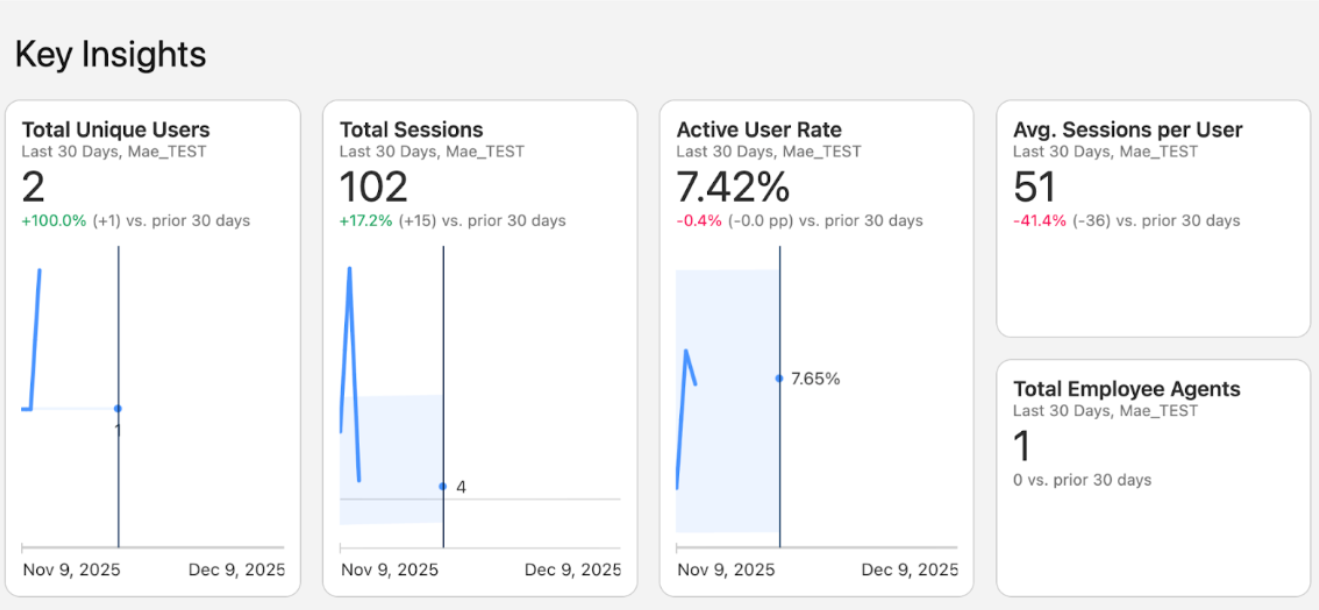
In order to generate actionable insight into how these agents were performing, Engine turned to some of the purpose-built analytics applications powered by Tableau Next, available directly within Agent Analytics in Salesforce. One example is Agentforce Observability, which gives Engine insights into agent adoption, optimization, quality and health monitoring. Service Insights gives service leaders and agents an at-a-glance view of case volume, escalations, SLAs, and CSAT scores, along with predictive and prescriptive guidance on where to focus.
“One thing we found really nice about Tableau Next, and the Data 360 connectivity, is the out-of-the box ability to build dashboards and reports that then we can expand upon with customization,” said Demetri Salvaggio, VP of Customer Experience & Operations. “We love that ability to take a feature functionality that's available out of the box and extend it, customize it, and shape it to the needs of the business.”
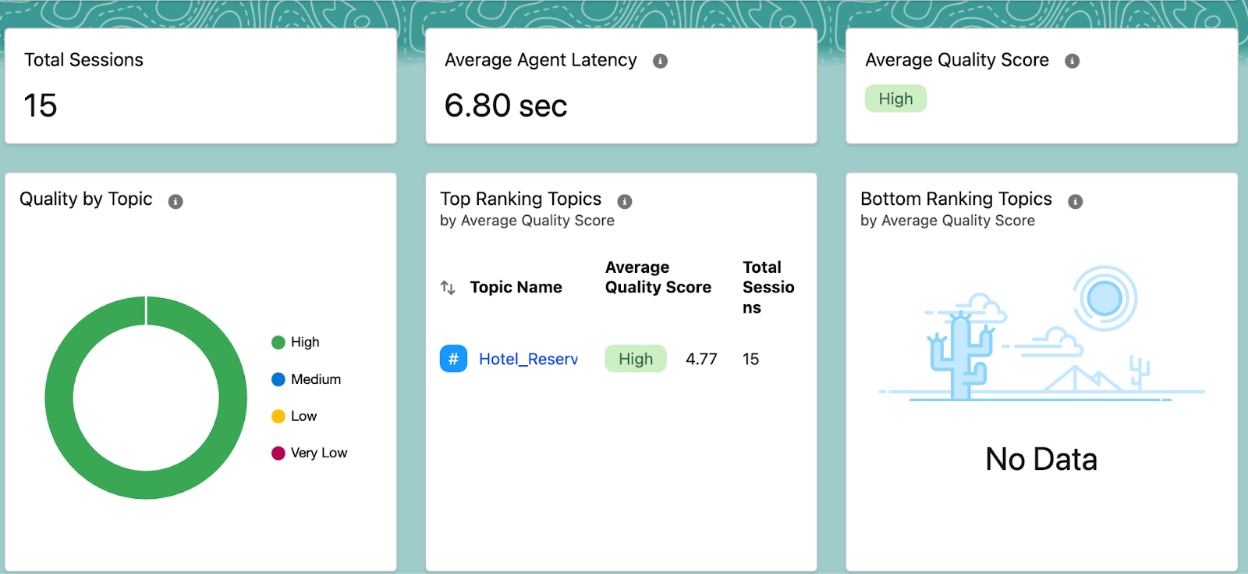
Using Agent Analytics, Engine can monitor the topics each agent is being asked about as well as the moments it generates. A moment is a specific, observable event or action within an interaction: detecting a greeting, confirming intent, or closing a conversation. One recent example is Engine’s discovery that some prospective employees were querying Eva about application status, allowing the data team to escalate the issue to its people team.
“Agentforce Observability and the rest of the pre-built apps that are powered by Tableau Next have transformed how we deploy and scale Agentforce across our business,” said Demetri Salvaggio. “Engine fields over 530,000 customer inquiries a year, and with near-real-time visibility into every interaction, we can see exactly how our AI agents perform, learn, and make decisions. That level of insight not only ensures accuracy and quality for our customers, it builds trust across our teams, allowing us to confidently expand Agentforce into customer service, sales, and internal operations without constantly adding headcount. Observability is the foundation that turns AI from a tool into a trusted, continuously improving teammate, and you can see the results in our significant CSAT improvements.”
Every Topic, Every Moment
As the data team built their confidence in these tools, they also began building custom analytics using Tableau Semantics, bringing in data from across the organization to inform their own Tableau Next dashboards. This richer use of Tableau Next significantly increased the value Engine saw from its implementation.
I check the two Tableau Next dashboards that sit on top of Data 360 every single day because I want to see how our topic scoring and our intent scoring is going, but also to look at security issues like prompt injections
Another valuable benefit is the semantics models in Tableau Semantics, and their ability to track variances between the cost of goods sold and what Engine is charged for hotels, flights, and car rentals. This process already has helped Engine reconcile millions of dollars in charges that it can bring to the attention of its partners.
Engine also values the ability to pose natural-language questions to its analytics agent in Tableau Next and get narrative explanations as well as auto-generated visualizations. This is a feature they are looking to launch into Slack soon.
Slack as Command Center
Slack is the perfect communication channel for the fast-paced world of travel, and Engine describes it as a command center where all employees connect. With single sign-on and more than 100 integrated tools, everyone at Engine can work directly in Slack without switching tabs. Engine executives appreciate being able to pose queries on topics like lead or case volume and feel confident that the data they receive is accurate and up to date.
Engine also unlocked AI in Slack, enabling daily recaps, file summaries, and enterprise search across Slack, Salesforce, Confluence, and beyond. “AI in Slack is our internal unlock,” said John Siladie, Engine Chief of Staff. “It enables our people to get answers instantly and keep moving.”
Engine is currently building a Slack agent that will pull data from Data 360 in response to a question, generate a visualization, and share it with the right line of business owners. Engine’s long-term goal is to give every employee their own AI assistant inside Slack.
My vision is a world where no one has to ask me or my team to build them a Salesforce report anymore. Users can just go into their Slack, into Salesforce, into any system and have that agentic experience and get answers that are grounded in reality.
The Tableau Difference
By tracking its Tableau dashboards to see how customer satisfaction is affected as it implements new features and functionality, Engine can focus both its AI and human agents on servicing customers faster and more effectively. Having data that concurrently measures human and AI agents on the same dashboard is another valuable feature of Tableau Next.
The results speak for themselves. Engine has seen a 20 percent increase in overall CSAT since it started to track insights and data within Tableau Next, as well as a resolution rate of 50 percent of customer inquiries using virtual agents. The company has also realized $2 million in savings based on the ability to manage higher customer volume while controlling employee costs.
The Engine data team credits Tableau Next with empowering them to focus on customer satisfaction rather than the competition.
Tableau Next helps us find insights faster. The out-of-the-box analytics have allowed us to really understand where the opportunities are to improve our agent, Eva. We've taken our customer satisfaction score with Eva from a 3.7 out of 5 stars to a 4.3 by using Tableau Next. Tableau Next really starts to become that shift from how we think about traditional BI dashboards to agentic analytics. No one else is really doing that the same way.